Why Flux 3 Represents a Shift in Multimodal AI Design
When I started working with generative models a few years ago, the idea of a single system handling images, video, and audio felt like a distant goal. Most tools specialized in one modality. You had separate pipelines for text-to-image, text-to-video, and text-to-audio. Each required its own architecture, training data, and inference setup. The overhead was substantial. So when Black Forest Labs introduced flux 3, it caught my attention not because it was another model, but because it was designed from the ground up as a multimodal foundation model. That changes how we think about building real-world AI applications.
In practice, a multimodal foundation model means you train one unified architecture on data from several modalities at once. The model learns relationships between text, images, video, and audio. It can generate new content in any of those forms, and it can also understand inputs across them. For example, you might give it a short text description and get back a video with synchronized audio. Or you might feed it an image and ask for a descriptive caption. This kind of cross-modal learning is what separates modern generative AI from earlier single-task models.
What Makes Flux 3 Different
The engineering behind flux 3 builds on advances in diffusion models and transformer architecture. Diffusion models have become the standard for high-quality image generation and video generation because they produce sharp, coherent outputs. Transformers handle long-range dependencies well, which matters when you are generating a sequence of video frames or a minute of audio. Combining both inside one system is not trivial. Black Forest Labs had to solve problems around model scalability and training stability. The result is a model that can generate images at high resolution, produce video clips that maintain temporal consistency, and synthesize audio that matches the context of the visual content.
One detail that stands out is how flux 3 handles text prompts. Traditional text-to-image models often struggle with complex scenes. They mix up objects or miss spatial relationships. Flux 3, by leaning on a transformer architecture for encoding the prompt and a diffusion backend for generation, shows better adherence to the prompt. This improvement comes from training on aligned multimodal data, where the model learns that a phrase like "a red car parked under a bridge at sunset" corresponds to a specific combination of visual, temporal, and auditory cues. That kind of alignment is what gives the model its visual intelligence.
Applications Across Modalities
I have seen teams use flux 3 for rapid prototyping in game development. They generate concept art, short animations, and ambient sound effects from a single set of text descriptions. This cuts down the time between idea and testable asset. In film pre-production, storyboard artists can generate sequences with rough audio to convey mood before committing to full production. The ability to generate all three modalities from one model also simplifies the AI inference pipeline. Instead of chaining separate models for each output, you run one forward pass. That reduces latency and lowers the chance of error propagation between models.
Another area where flux 3 shows promise is accessibility tools. For someone who is visually impaired, a system that can describe a scene aloud in real time requires both computer vision and natural language processing. With flux 3, you could build a system that takes a photo from a phone, generates a natural language description, and then reads it out using text-to-audio synthesis all within the same model. The unified architecture makes the integration tighter and the response more coherent.
Trade-offs and Practical Considerations
No model is perfect. Flux 3 is large, and running it for real-time applications requires strong hardware. Model scalability is a trade-off. Smaller models are faster but produce lower quality. Flux 3 sits at the higher end of quality, which means you need good GPU resources for inference. For teams without access to high-end hardware, cloud-based inference or distillation into smaller models might be necessary. Black Forest Labs has not released official distillation recipes yet, so the community has been experimenting with quantization and pruning on their own.
Another consideration is data licensing. Training a multimodal foundation model requires huge datasets that span text, images, video, and audio. The sources and licenses for that data matter if you plan to use the model commercially. Flux 3 uses publicly available datasets where possible, but you should always check the specific terms for the version you are using. This is not unique to flux 3; it applies to most generative AI models today. But it is worth repeating because the legal landscape around training data is still shifting.
How Flux 3 Compares to Other Models
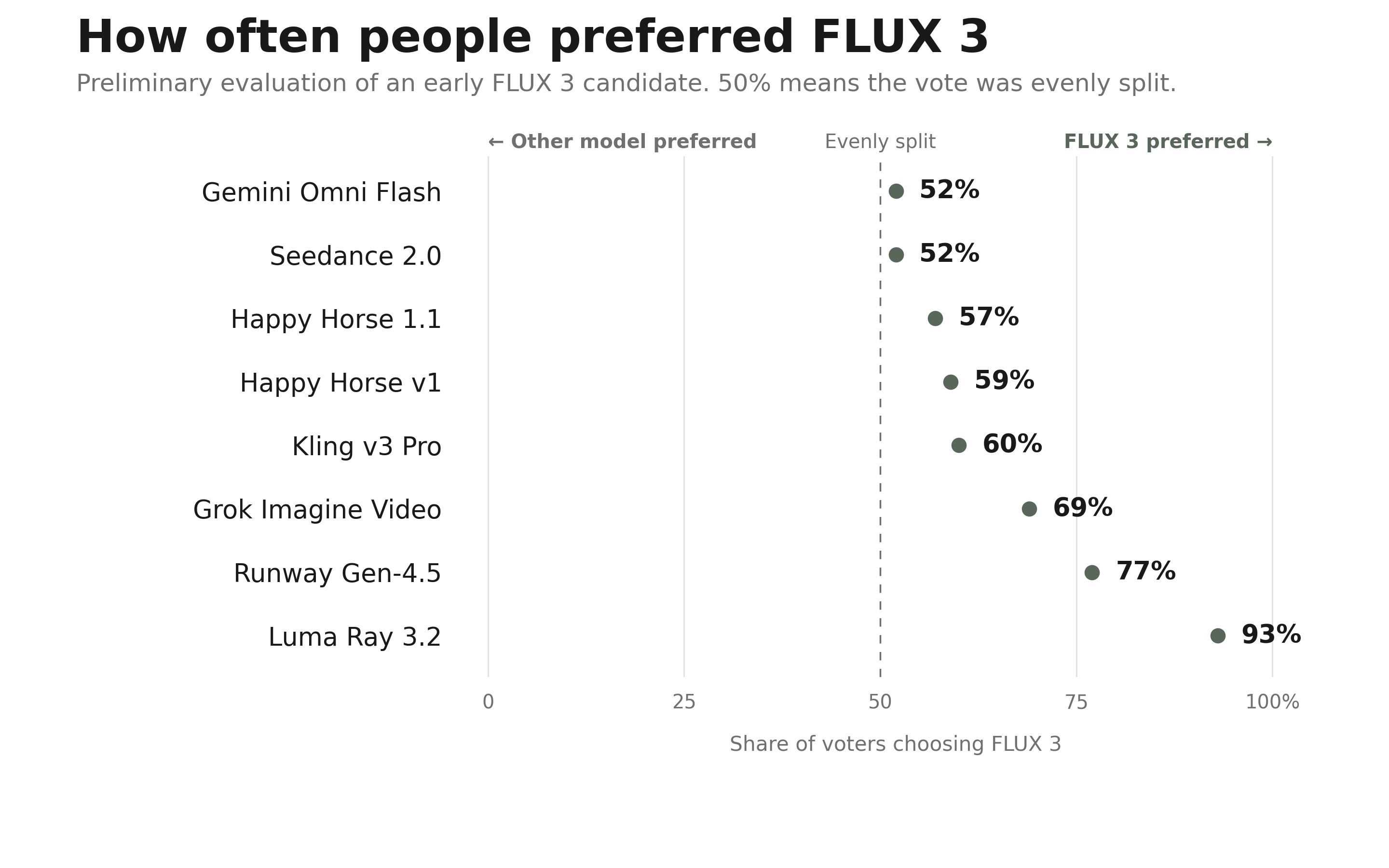
If you have worked with separate models for each modality, you know the pain of mismatched output quality. An image generator might produce beautiful results, but the video model you pair it with might lag behind in resolution or temporal coherence. Flux 3 avoids that because all modalities are trained together. The image generation quality is on par with dedicated models like Stable Diffusion XL, and the video generation quality competes with specialized video models. Audio generation is newer territory, but early benchmarks show that flux 3 produces clean speech and environmental sounds.
Where flux 3 really pulls ahead is in tasks that require understanding across modalities. For example, generating a video that continues from a still image, with matching audio. Or taking a noisy audio clip and generating a clean version while also producing a textual transcript. Those tasks benefit from the cross-modal learning baked into the training. A single-modality model cannot do that without external stitching.
Getting Started with Flux 3
For developers and researchers who want to try flux 3, the model is available through the flux3.dev platform. The API supports text-to-image, text-to-video, and text-to-audio endpoints. You can also fine-tune the model on custom datasets if you have a specific domain in mind. The documentation includes examples for each modality and for chaining them together. I recommend starting with the image generation endpoint to get a feel for prompt sensitivity, then moving to video and audio once you understand how the model interprets your inputs.
One tip: prompt engineering matters more with multimodal models than with single-modality ones. Because the same prompt drives all three outputs, you need to be explicit about which modality you care about. For instance, if you want a video with a specific camera motion, include that in the prompt. The model will try to honor it. If you omit it, the model might default to a static shot. This is a learning curve, but it is manageable.

Looking Ahead
Flux 3 is not the end of the line for multimodal foundation models. It is an important step toward real-world AI that can perceive and generate content the way humans do: across senses. As hardware gets cheaper and models become more efficient, we will see these architectures embedded in everything from creative tools to assistive devices. The work Black Forest Labs has done with flux 3 sets a strong baseline for what a unified architecture can achieve. For anyone building applications that mix images, video, and audio, it is worth a close look.